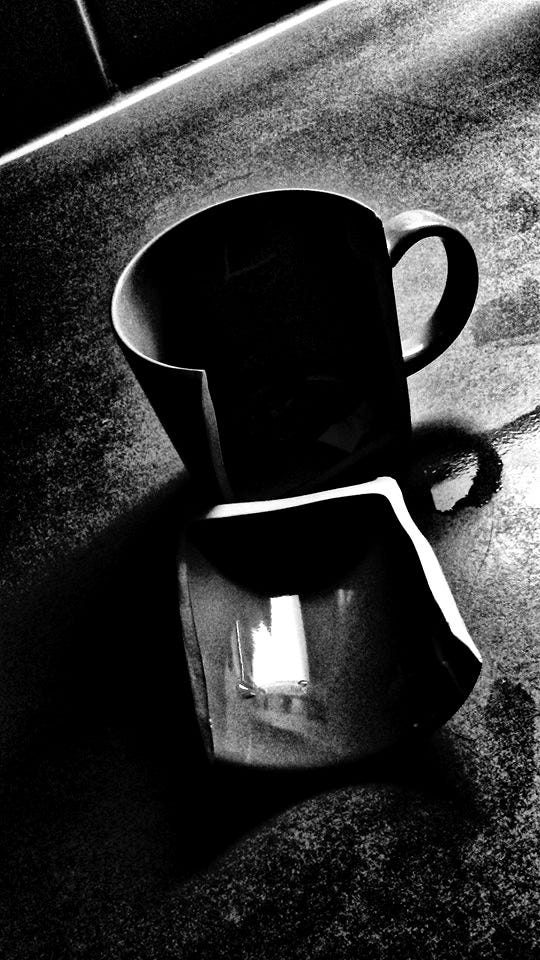
Incendiary abstracts #23
Based on a note I wrote (when I was writing them).

Common sense will not accomplish great things. Simply become insane and desperate. (Yamamoto Tsunetomo, Hagakure, p. 32)
But what are those great things that burst forth from desperation and insanity? A good death, says Tsunetomo, a samurai. But I’m not seeking death, good or bad, nor am I a warrior in any sense. Or have I mistaken the task at hand? Perhaps I am seeking a death, not of the physical kind but of the emotional kind. Having my raw emotion captured in alphabetic characters on your screen, dear unsuspecting victim, and allowing it to expire with unwavering force, isn’t that the aim of writing in public? Trusting, moreover, that you, my unsuspecting victim, will be agitated and exhausted by this force in your solitude.
Solitude is the operative word. I must write as if I were writing to the last person on Earth. Never address crowds! Try as I might, I won’t have anything to do with the crowd, least of all because they are the many. What good does the opinion of the many matter to me? They don’t make me matter much at all, quite the opposite in fact. They reflect how low I have sunk. I would rather have the opinion of one good person.
In an age when only the madding crowd matters, it is easy to be deceived into following the lowest common denominator. In fact, one must either follow it or face a kind of death. The Romans didn’t equate the phrase inter homines esse desinere with death for nothing. We know what the denominator is. It goes by many names and wears many masks, but it always serves something or someone other than itself. The rock bottom is near when you witness them begging or advertising their art. As soon as the cutting edge is exchanged for a handle blank and turned away from the dear victim, art serves a master other than itself. For all intents and purposes, it is then dead.
This is not the death I seek.
In ancient times people were, for good or for ill, honest about their cruelty and greed. They would sit in the arena all day long, cheering for death until the beasts ran out of human prey. Munera, venationes and bread were all they needed to keep melancholy away. They would burn and cut innocent victims with fire and sword for sheer amusement, just as the masses now deride and violate each other online without ever feeling the cuts and burns themselves. The modern crowd comes at you with weapons that keep them at a distance from the carnage. Otherwise, they ambush you in the dark and stab you from behind. While neither crowd pleases me, I would rather address the former, simply because it acknowledges the gravity of the situation.
These days, everything popular has an eerie quality of frivolity to it. “I know it’s not real but it feels real,” is the best one can expect from the generations born into this cesspool of quantified wonderment. Nothing in human nature has changed since the times of the Colosseum blood sports. As an arena, social media is merely a sophisticated, virtual killing floor where plebs can safely decimate each other.
If human inanity remains the same, so does its wisdom. There is nothing I can learn from modern writers who stoop to lows I cannot follow by prostituting their words as though they were haunted dolls. The final cause of their words is irrelevant to me if the efficient cause lacks self-awareness. I don’t look for quality in words, only sincerity:
The following also was nobly spoken by someone or other, for it is doubtful who the author was; they asked him what was the object of all this study applied to an art that would reach but very few. He replied: “I am content with few, content with one, content with none at all.” The third saying—and a noteworthy one, too—is by Epicurus, written to one of the partners of his studies: “I write this not for the many, but for you; each of us is enough of an audience for the other.” Lay these words to heart, Lucilius, that you may scorn the pleasure which comes from the applause of the majority. Many men praise you; but have you any reason for being pleased with yourself, if you are a person whom the many can understand? Your good qualities should face inwards. Farewell. (Seneca, Moral Epistles, #7)
Given what we are, the bigger the crowd that receives me, the less satisfied I should be with myself. Perhaps that is my art then? The art of diminution, of shrinkage? I still don’t know what it is. If I did, I don’t think I would have anything to write to you about. Whatever that art is, it must be a mimicry of death, desperation and insanity. If any of these emotions have meaning, they are only found in extremes. One doesn’t have to be great oneself to deal with great things, as long as one understands what great things are and what they are not. The commonplace doesn’t preclude immensity. But whatever the commonplace that inspires art, it must be extreme in some sense, at the very least in its sincerity and urgency.
However, Remy de Gourmont urges me to respect all aesthetic endeavors on a continuum; that the success of any art is destined to follow the aggregate of human emotion, the common pleasurableness of the work:
[…] the aesthetic caste does wrong to laugh at the people’s pleasures. It also does wrong when it monopolizes certain words and refuses to call works of art those compositions which, no less than those which they themselves admire, have as their aim to stir emotion. It is a question of quality, not of essence. (Remy de Gourmont. Decadence and other essays on the culture of ideas, 1921. p. 97)
That is how we arrive at the many successes of popular art; or art measured by the number of people it pleases. Something dark and wistful creeps beneath that fashionable sheen. What pleases people the most is not a matter of quality, nor is it a matter of essence. Regardless, the world has quietly agreed that whatever generates the most views is good. The conditions we live in necessitate a metric, and so we have leader boards. What wonders!
Anyone can be an artist, even a good one, with enough practice. That is the nature of art. But to be a good person, now that is a question of essence. Whether or not the latter should have any bearing on the former is a matter of personal taste. A good artist—whatever the metric used to measure his quality—need not be a good person. In fact, he may be the exact opposite.
Whatever art is, it resides, along with the daemones of love and hate, rage, fear and delusion, in the always unpredictable regions of the human psyche. There it awaits for its release, in the clutches of a particular emotion for the singularly awkward pleasure of this poor Substack writer, only to escape the common sense of the crowd.
But pleasures are as varied as individuals. Unfortunately, pleasure casts an ominous shadow over everything human. It is invariably associated with some form of will to dominate others. This was true with the crowds of the Colosseum as it is true now with the multitudes of social media. The history of human pleasures would feature our greatest lovers, leaders, fools, abusers, murderers, torturers and gluttons; some of whom would also be our greatest saints, artists and benefactors.
The pure impulse for survival in the lower animal mutates into a panoply of more or less pathological desires by virtue of human intellect and understanding. In some cases, these desires transcend the limits of our biology. We forget that technology is also an art: the artes mechanicae, the vulgar or servile arts, the deadliest of them all. When desire dominates the intellect and puts it to work, we never fully understand what we are creating. This was the case with the atomic bomb. The same is true of this pathetic little discharge, which I would never deign to call art. Yet it is motivated by the same impulse as the making of the atomic bomb.
Greatness can be found in the commonplace, but it will never be brought forth by common sense alone. That means danger. Whatever the efficient cause of such art, it is desperate and dangerous. Any reference to art as a function of pleasure is dangerous simply because pleasure can take terrifying forms. But it serves us to remember that if we accept insanity and desperation at one end, we have to accept it also at the other, lest we want to be hypocrites.